The Chicken Dinner System: How Independent Consultants Build a Predictable Project Pipeline
Jul 21, 2026
There has never been a better time in history to be an independent consultant. The pandemic normalized remote work. AI leveled the playing field. And companies are searching for world-class talent to solve specific problems on a project, interim, or fractional basis.
The independent workforce is growing dramatically as more experienced professionals turn to entrepreneurship in the wake of layoffs, return-to-office mandates, and restructuring.
In January 2026, LinkedIn revealed that Independent Consultant was the seventh fastest-growing role in the US.
In the 2025 State of Independence Study, MBO partners reported that the number of independent consultants making $100,000+ increased by 19% to 5.6 million.
The opportunity to build a fulfilling business and work on your own terms has never been better.
But 45% of independents say their top concern is “lack of predictable income.”
They’re riding the revenue rollercoaster. Serving clients, making good money, and then the project ends. They don’t know where the next client is coming from. They survive off savings for a couple months while they search desperately for the next project.
The feast-or-famine cycle is exhausting.
How do Independent Consultants Find Clients?
Most independent consultants get their first few clients through referrals from people they used to work with, or know professionally.
But referrals are a bonus, not a business plan.
They’re unpredictable, and eventually they dry up.
So most independent consultants spiral into panic mode, trying new tactics to attract clients. They post more on LinkedIn. Attend more networking events. Have endless “virtual coffee chats” with people in their industry. Launch a newsletter. Start a podcast. Speak at conferences. Host webinars.
And, when things get really desperate, they search for a silver bullet and throw money, time, and energy at whatever tactic promises the fastest results:
One consultant I know spent $300 on LinkedIn ads which generated 20,000 impressions, 1,000 website visits, and exactly zero meetings.
Another bought 2,000 email addresses from a data broker, sent them all a cold email, got zero responses, and their account terminated by HubSpot.
Another spoke at 9 conferences in 11 weeks—footing the bill for his own travel—and booked zero paid speaking gigs, a few fruitless meetings, and no clients.
Another spent $851 on Google Ads, got 4 email sign-ups, and zero paying customers.
Another made 48 cold calls, left 48 voicemails, got 2 call backs, and no clients.
The problem isn’t the tactics themselves. Everything works, from networking to podcasting and advertising to cold calls. But you need to apply the tactics as part of a bigger strategy. A client development system.
As consultants, it’s easy to see what’s not working in our clients’ businesses, because we’re on the outside. They’ve developed blindness to the problems that seem obvious to us. We spot disconnected processes, unclear priorities, and hidden bottlenecks almost immediately.
But it’s much harder to diagnose issues inside our own businesses.
We're standing inside the system.
And that's why the biggest problem in your client development is often the one you can't see.
And until you identify the real constraint, it's remarkably easy to spend months solving the wrong problem.
That's why I created The Chicken Dinner System.
The Chicken Dinner System for Predictable Project Pipeline
The Chicken Dinner System is a practical client development system built for independent consultants—not internet marketers, corporate sales teams, life coaches, or social media influencers—but seasoned experts who have left corporate careers to find the freedom and independence to live and work on their own terms.
At its core are The Five Disciplines of Client Development:
- Clarity – How you position your services
- Credibility – How you signal expertise
- Connection – How you initiate contact
- Conversion – How you lead conversations
- Consistency – How you sustain momentum
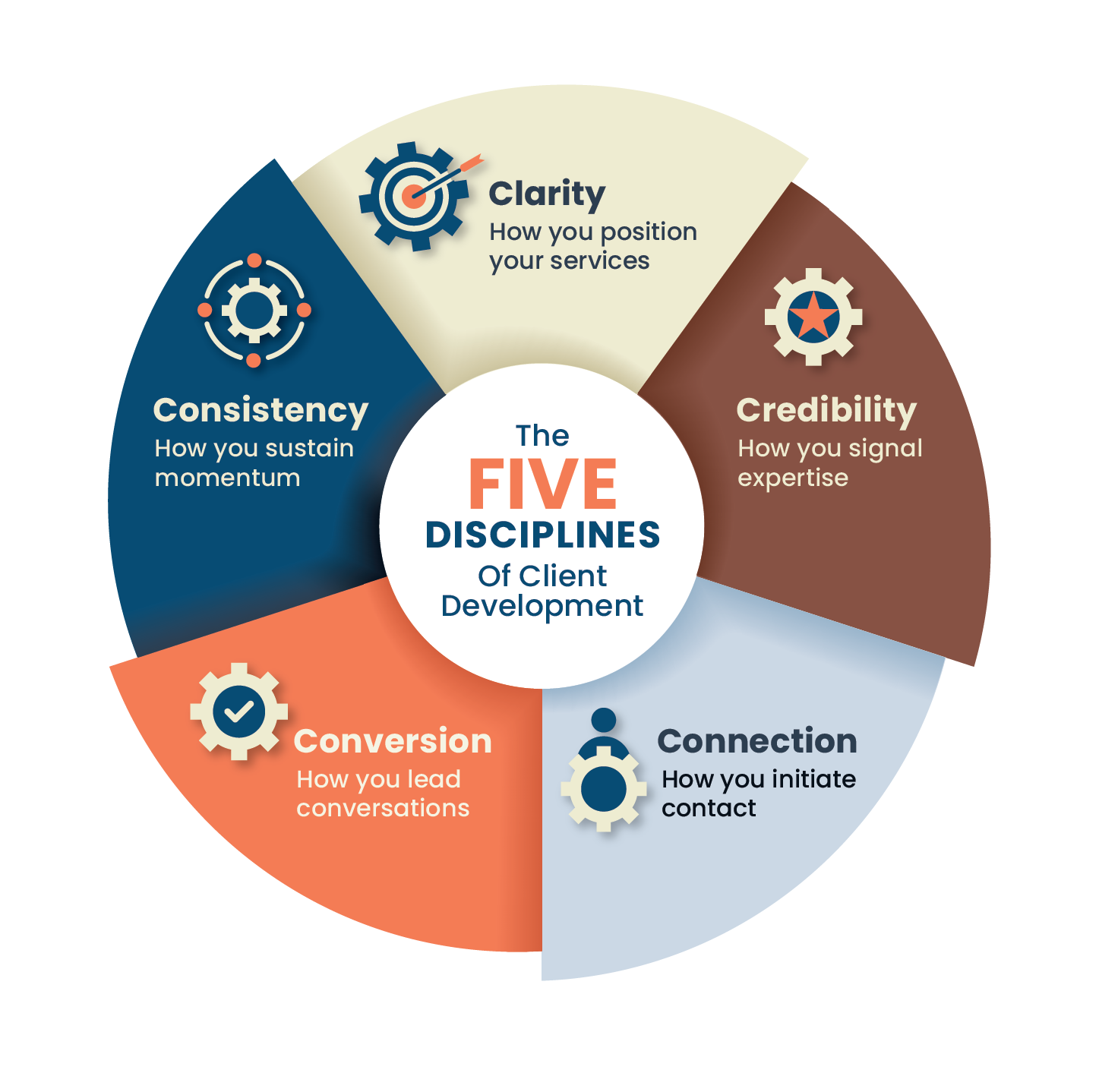
The Five Cs are the core disciplines of client development. They work together to turn expertise into predictable project pipeline by ensuring the right people understand you (Clarity), trust you (Credibility), talk to you (Connection), decide with you (Conversion), and that you keep momentum when conditions aren’t perfect (Consistency).
The Chicken Dinner System works because each C removes a specific failure point. Clarity ensures you have a clear offer, for a specific person with a specific problem. Credibility ensures they trust you before they even talk to you. Connection ensures you don’t wait to be discovered. Conversion ensures conversations lead to professional commitments. Consistency ensures the system keeps running even when confidence dips or outcomes lag. Remove any one C, and the performance of the system degrades.
Together, the Five Cs transform expertise into predictable project pipeline because they reinforce each other, working together in a system, each discipline making the others stronger.
Most consultants don't struggle because they're weak in all five disciplines, but because one discipline is limiting the effectiveness of all the others.
Discipline #1: Clarity – How You Position Your Services
Do people instantly understand who you help and the problem you solve?
Many consultants accidentally position themselves as smart generalists.
The market rewards specialists.
Clarity ensures your expertise is translated into a specific, well‑defined offer for a clearly scoped Ideal Client—so the right people immediately recognize “this is for me,” instead of seeing you as a generic service provider. With a clear offer and positioning, you act as a magnet—attracting the right clients and repelling the wrong ones.
Without Clarity:
- You’re asking what a potential client wants rather than telling them what you do
- Referrals don’t come at all, or they feel like poor fits for what you do
- You’re doing customized projects that don’t feel repeatable
Discipline #2: Credibility – How You Signal Expertise
Do you look like the obvious, low‑risk choice for this problem?
Most independent consultants lose something when they leave corporate:
Borrowed credibility.
Inside a large company, the logo does a lot of work. Outside that company, you must build trust differently.
Credibility is the discipline of being visible with an authentic voice, clear point-of-view, real outcomes, and social proof—so the market repeatedly sees evidence that you understand the problem and can deliver results, even without a corporate brand behind you. Publishing a body of work across multiple mediums and channels signals that you are a trusted expert and advisor before any conversations begin.
When Credibility is weak:
- You don’t get inbound leads
- You can’t charge premium prices
- You compete as a commodity, not a trusted expert
Discipline #3: Connection – How You Initiate Contact
Can you intentionally create new opportunities to talk with the right people?
The strongest consultants don’t rely on chance. They don’t wait on referrals or hope for inbound leads.
They create opportunities.
Connection is proactive, professional outreach—everything that happens before the first live conversation—so you can reliably initiate contact with relevant decision‑makers instead of waiting on referrals or hoping content alone produces inquiries. Being skilled in connection is not about volume or pitching, but the discipline of creating real relationships with potential clients, referrers, and business partners.
When Connection is weak:
- Your network of potential clients doesn’t grow
- You rely entirely on referrals
- You wait and hope for clients to find you
Discipline #4: Conversion – How You Lead Conversations
Do conversations with potential clients consistently lead to clear next steps and paid work?
Conversion is the discipline of decision leadership: guiding serious, professional conversations so they lead to clear commitments and signed agreements. Rather than persuading or pressuring, Conversion focuses on leading a professional exchange of value: surfacing problems, discussing budget openly, navigating negotiations professionally, and helping both sides decide whether and how to move forward together.
Many consultants dislike “doing sales” because they misunderstand it.
Conversion is not convincing, manipulating, or schmoozing. It’s a professional exchange of value between two parties to decide whether they should work together.
When your Conversion is weak:
- Your meetings with a potential client seem to drag on without clear outcomes
- You discount your work to try and save the deal
- You do “free consulting” and give away your intellectual property trying to win the work
Discipline #5: Consistency – How You Sustain Momentum
Do you have a repeatable rhythm that creates momentum even when you get busy or your confidence dips?
Consistency is the discipline of showing up and executing the right actions week after week—regardless of confidence swings, emotional noise, or recent disappointments—so momentum compounds over time. It combines a clear operating rhythm with the courage to ask hard questions, lead professional conversations, and keep moving forward after rejection, setbacks, or stalled deals. This isn’t about motivation or positive thinking, but professional self‑management under uncertainty.
When Consistency is weak:
- You’re stuck in start-stop cycles of activity
- You procrastinate because you’re not sure what to do next
- You overthink every LinkedIn post, blog article, and outreach email, striving for perfection
Failure Modes: What Happens When a Discipline Is Missing?
If you don’t have a predictable project pipeline, one or more of the Five Cs is undeveloped or under-practiced. This makes all the other disciplines harder.
Without Clarity → you’re misunderstood
Without Credibility → you’re not trusted
Without Connection → nothing starts
Without Conversion → nothing completes
Without Consistency → nothing compounds
You do not need perfection in all five areas.
But a weakness in any one discipline can throttle the performance of the entire system.
Most consultants assume they know which discipline is holding them back. They're usually wrong.
How to Know Where to Begin Finding Clients
You already know something isn’t working. You’re relying too much on referrals, long-term clients, or handouts from that boutique firm you subcontract with.
You’re discounting to win the work. (And then resenting the 7am project meetings because you’re not getting paid what you’re worth.)
Or you’re riding the revenue rollercoaster, climbing high some months only to hit rock bottom the next.
This isn’t because you’re doing something wrong. It’s because you’re too close to see it clearly.
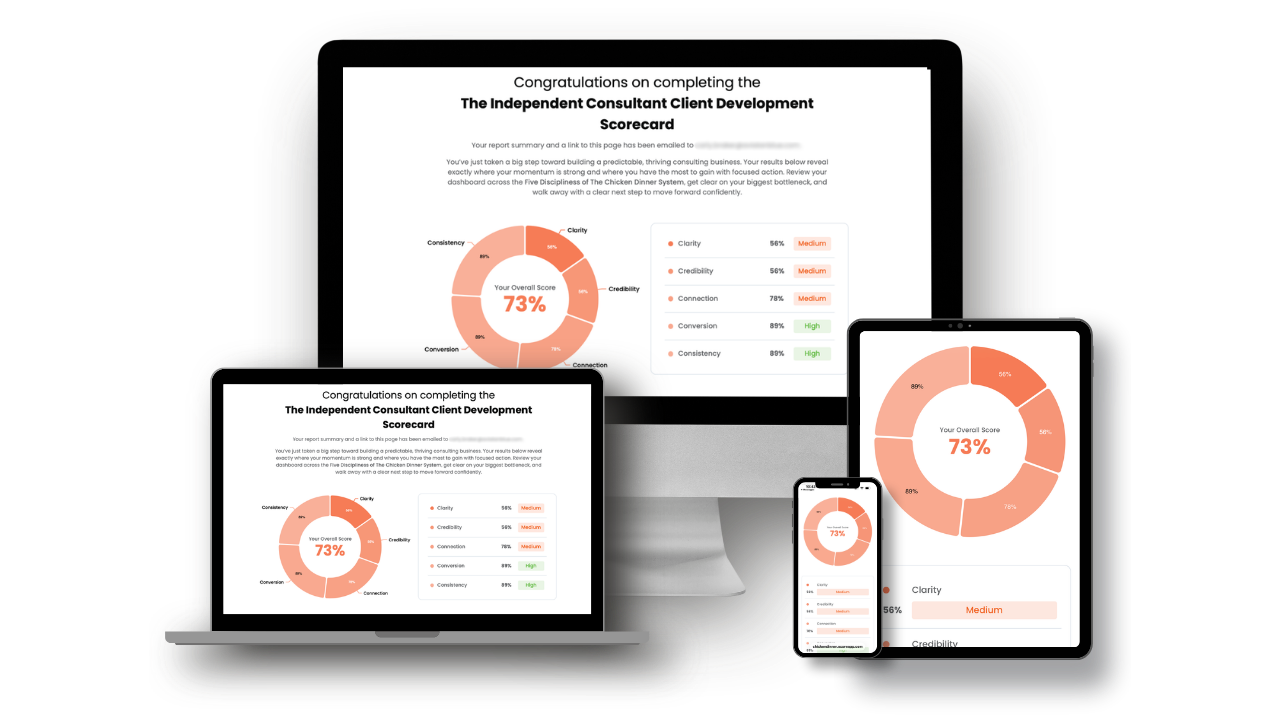
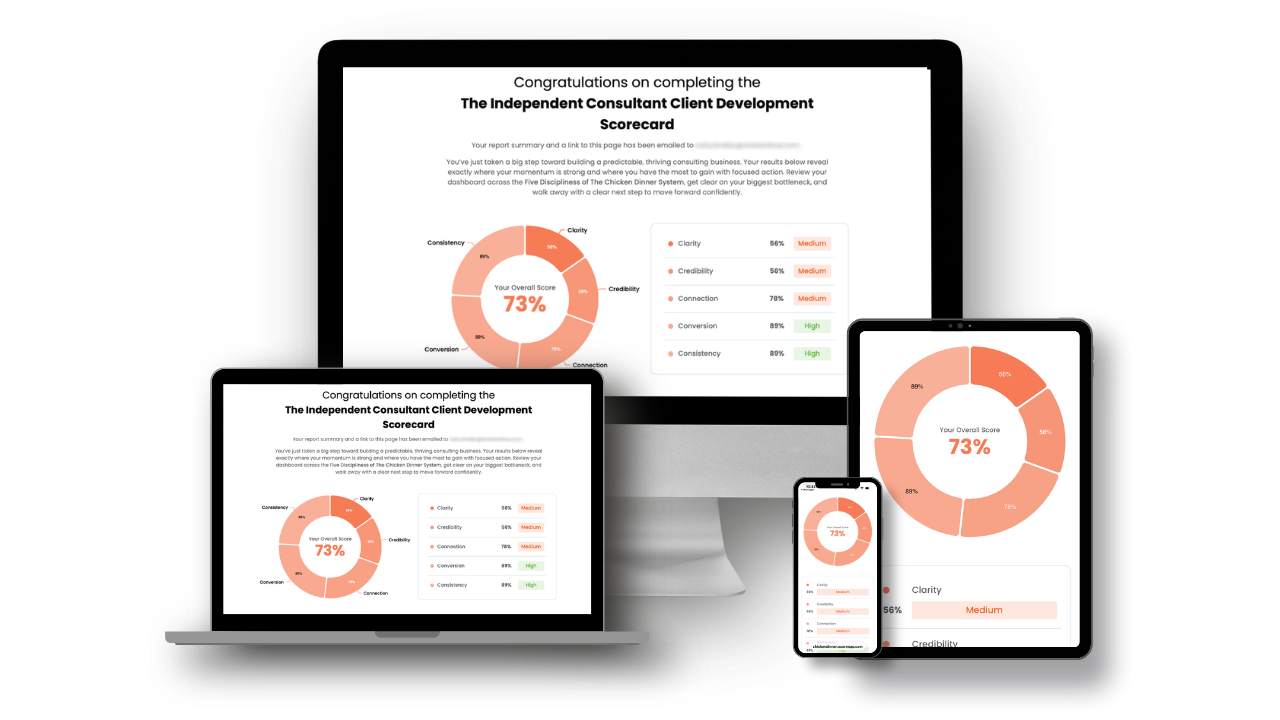
I built a tool to help you step outside your own perspective and actually see your client development system clearly.
You’ll answer 20 questions in about five minutes.
It's fast, free, and you’ll see exactly where you stand and where to focus next.
Take the Client Development Scorecard for Independent Consultants.
The Weekly Briefing to Win Big, Meaty Consulting Clients
Read the Weekly Nuggets newsletter for one juicy insight, a curated resource, a tool I actually use, a winning LinkedIn post recipe, and a quote worth pondering. Served hot every Friday so you always know what to cook up next in your consulting business—only for subscribers.
Subscribe now or read an issue first.
100% free. Unsubscribe at any time.
We'll never sell your info because we're not sociopathic turkey vultures.
ABOUT THE AUTHOR